
Get In Touch
If you’re looking for professional arborist services in the Portland metro area or Southwest Washington, we’re here to help. Whether you’re concerned about tree health, safety risks, or long-term maintenance, our team is here to provide guidance and recommendations tailored to your unique property.
Submit A Request
What to Expect
-
Once submitted, we will review your request and follow up if additional details are needed.
-
For new clients, our office will reach out to you with booking and payment information to schedule your Safety or Health Assessment.
For Pruning and Removal Estimates, we will schedule an on-site evaluation to assess your project and discuss your concerns and goals.
-
You’ll receive a detailed proposal with our recommended scope of work and next steps.
-
Once the proposal is approved, we will reach out with scheduling availability and request a deposit for larger projects of 25% of the overall cost to book your project.
Contact Details
info@samsaratreecare.com
503.406.8046
3210 SE 73rd Avenue
Portland OR 97206
Monday - Friday
8-5 pm (PST)
Service Areas
Serving the Portland Metro Area & Southwest Washington
Portland, OR
Vancouver, WA
Lake Oswego, OR
West Linn, OR
Beaverton, OR
Oregon City, OR
Gresham, OR
Happy Valley, OR
FAQs
-
We provide professional arborist evaluations followed by detailed proposals outlining recommended work.
-
We serve the Portland metro area and Southwest Washington, including Vancouver, Camas, Washougal, Lake Oswego, West Linn, and surrounding communities.
-
In many cases, yes. The City of Portland has regulations that protect certain trees depending on their size, species, and location. Some trees can be removed without a permit, while others require city approval. Our arborists can help evaluate your tree and guide you through the permit process if necessary.
-
Tree removal rules in Vancouver vary depending on zoning and property type. Some removals require permits, particularly for larger trees or trees in protected areas. If you’re unsure, our team can help determine whether a permit is required before work begins.
-
Many trees in the Portland and Vancouver area are best pruned during the dormant season in late fall or winter. However, some species require pruning at specific times of year to avoid disease or stress. An arborist evaluation can determine the best timing for your particular tree.
-
Signs of a potentially hazardous tree include large dead branches, cracks in the trunk, leaning, root damage, or visible decay. If you’re unsure about the condition of a tree, a professional arborist can perform a tree risk assessment to evaluate safety concerns.
-
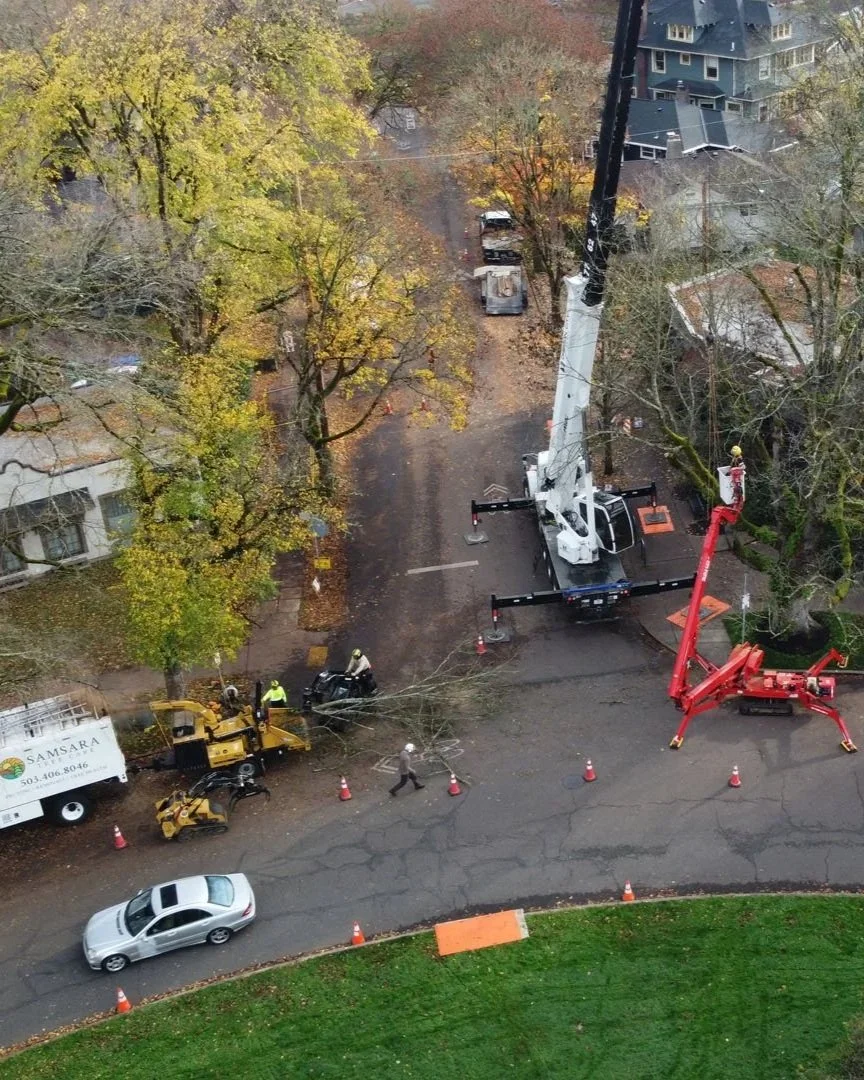
The cost of tree removal depends on several factors, including the size of the tree, location on the property, access for equipment, and nearby structures. Smaller trees may be relatively inexpensive, while large or complex removals may require specialized equipment and crane work.
-
During an evaluation, an arborist examines the tree’s health, structure, and surrounding environment. This includes looking for signs of disease, structural weaknesses, root issues, and potential hazards. Based on the assessment, the arborist provides recommendations for pruning, treatment, or removal if necessary.
-
Plant Health Care programs focus on improving the long-term health of trees through soil improvement, fertilization, pest management, and disease prevention. These proactive treatments help trees thrive in urban environments where soil conditions and environmental stress can impact tree health.
-
Most mature trees benefit from pruning every 3–5 years, though this varies depending on the species, age, and condition of the tree. Younger trees may require more frequent structural pruning to establish healthy growth patterns.
-
If a tree has been damaged during a storm, it’s important to assess the situation carefully. Broken limbs or partially fallen trees can pose serious hazards. Contact a professional arborist to evaluate the damage and determine whether pruning, cabling, or removal is necessary.
-
Yes. In many urban environments around Portland and Vancouver, soils become compacted or nutrient-depleted over time. Professional fertilization and soil treatments can help improve root health and support overall tree vitality.